
Introduction
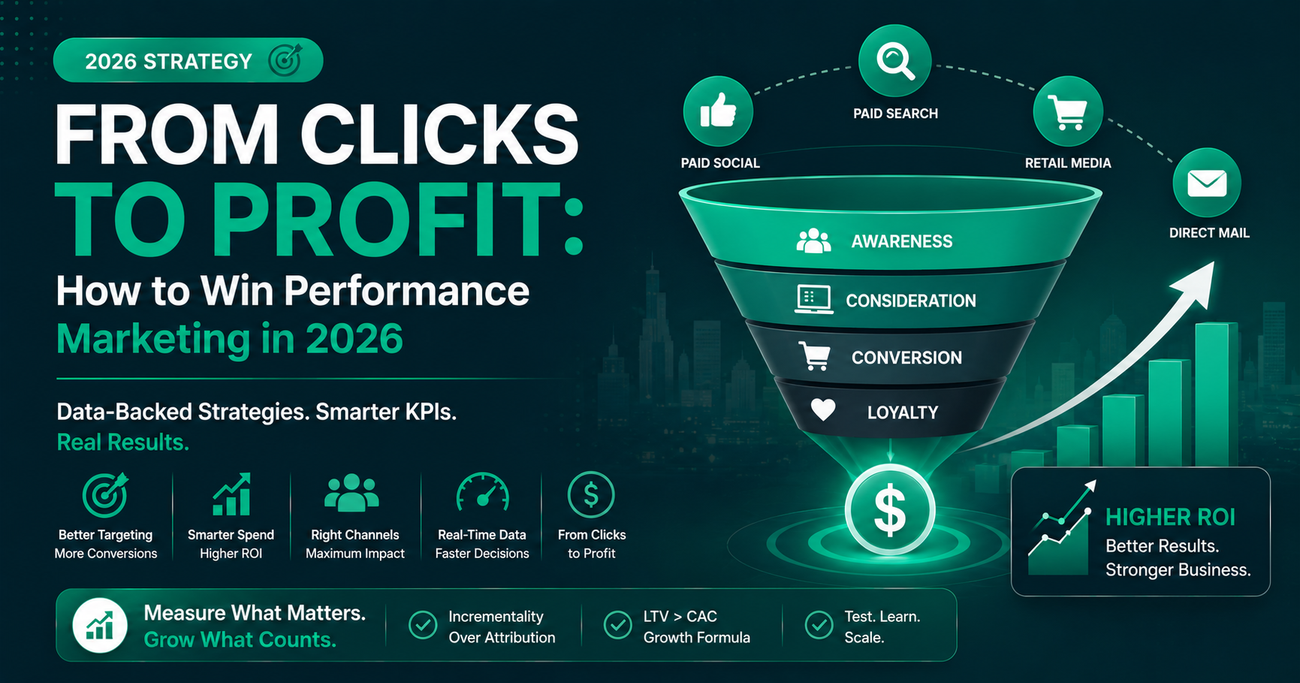
The world of performance marketing has arrived in a whole new era. According to a report by Winterberry Group, in 2026, the old strategy of getting more clicks and focusing on last-click attribution will not work anymore. This same report revealed that 71% of brands have intensified their focus on performance marketing in the last three years because of the benefits offered by artificial intelligence in customer acquisition, incremental sales, and retail traffic. However, even with all these efforts in investing in performance marketing, most companies continue to fail at making clicks translate into revenue.
The New Rules of Performance Marketing in 2026
There’s a new set of rules in play. The strategies of 2024 and 2025 won’t do anymore. A poll conducted among 750 C-level marketing professionals shows that 25% of marketing budgets don’t produce results due to AI noise and overinflated signals. The core challenge isn’t a lack of data; it’s an excess of data that doesn’t translate into action.
The “core four” performance channels continue to dominate: online display (57%), paid social (54%), direct mail (45%), and paid search (45%). But here’s what’s different in 2026. There has been an increase in retail media networks from 27% to 37% within a year. Direct mail is making its comeback, with 83% of panelists intending to increase their direct mail budget in 2026. Performance advertising has shifted from being a purely digital phenomenon to becoming omnichannel.
The shift from attribution to incrementality is perhaps the most significant change. A 2023 Skai/BWG study found no statistical correlation between reported ROAS and actual incremental ROAS. The number of teams has been optimized for years didn’t reliably predict business outcomes. In 2026, incrementality, lift, and confidence intervals are replacing what Advertising Week calls “certainty theatre”.
AI is no longer a feature layered onto platforms; it is the foundation. Meta’s advertising systems are now built on AI models like Muse Spark, designed to prioritize people and relationships over isolated actions. However, 70% of marketers are anticipating an increase in the effectiveness of AI usage within the next two years, with 58% anticipating efficiency improvements as well. The issue is not whether or not to implement AI, but rather how to implement AI without losing the human element.
Why Your Digital Marketing KPIs Are Probably Wrong
You’re staring at dashboards full of green arrows, yet your bottom line isn’t moving. Sound familiar?
Return on ad spend is a trap. Campaigns with high ROAS usually end up harvesting users who would have converted anyway. Metrics that can help you predict profitability include CAC, LTV, incrementality, and retention rate.
Incremental Return on Advertising Spend (iROAS) helps you calculate the incremental lift in conversions, which is a result of the advertising campaign. This is the metric that tells you whether you’re creating new demand or just harvesting existing intent.
For an ideal LTV: CAC ratio, it should be more than 3:1. Excellent campaigns have a payback time of 80-120 days. This is what the KPIs of digital marketing look like in 2026, not vanity metrics like impressions and clicks.
Marketing has to learn the language of revenue, margin, and market share to get to the table. Shifting from “activity” to “business impact” means tying every single dollar invested to a tangible business result. First‑party data is your new measurement foundation. With third‑party cookies fading, owned signals and unified analytics are non‑negotiable.
How to Acquire Performance Marketing Channels That Actually Scale
More channels don’t mean more profit. Smarter acquisition does.
Over 50% of performance marketers are expanding into new channels as social media returns diminish. Diversification is no longer an option; it’s a matter of survival.
In 2026, retail media networks account for 37% of brand mentions, a 10% increase from last year. Commerce media is taking up an increasingly large portion of advertisers’ budgets due to its ability to target users during that one crucial moment that traditional media misses when making a purchase. This year, commerce media is expected to reach nearly 21% of digital ad spending.
Performance TV is rated as the top channel for media spend in 2026 by 24% of respondents. Direct mail serves to boost digital media performance when deployed in conjunction with paid social and search. The channels that work best together are the ones that win.
Affiliation remains one of the few channels natively oriented towards “pay for performance” with a variable cost logic and shared risk. But performance-based marketing requires more than just choosing the right channels; it requires testing and validation.
At Seven Doors Solutions, we help clients acquire performance marketing channels by starting with a 90‑day test window, measuring incremental lift, and only scaling what proves profitable beyond the platform’s own reporting. The approach is simple but rigorous: prove it works before you scale it.
Pay-Per-Performance SEO: Is It Working in 2026?
Pay-per-performance SEO sounds like an excellent choice. You only pay for results, so there is nothing to lose. On the contrary, the pay-per-performance model may cause problems.
Performance-based SEO is a business model that allows companies to pay for SEO services if certain pre-agreed results have been achieved, e.g., better keyword placement, organic traffic growth, or lead generation. The appeal is obvious; the risk shifts away from the client. But the model is more nuanced than the headline suggests.
Pure pay‑per‑rank arrangements have a structural problem. Their goal is for agencies to concentrate on fast wins: less competitive keywords, simple technical changes, or methods that quickly change rankings but do not create any long-term authority. It might seem like a win to rank #1 on something nobody cares about or searches for, but this will have no impact on earnings whatsoever.
The tactics typically employed by pay-for-performance SEO agencies are focusing on low-value keywords, creating thin and/or scaled content, and aggressive link building via paid-for backlinks or private blog networks. While such links may provide temporary ranking boosts, later they can be ignored or penalized, thus weakening the website even further.
The preferred method, one that is gaining popularity within professional SEO agencies, is the hybrid approach: a minimal foundational retainer that ensures basic work gets done, plus bonuses for reaching certain milestones. This includes a technical SEO audit, on-page optimization, and content creation work needed to create authority.
AI and Automation – Friend or Foe?
AI won’t replace you, but a marketer using AI will replace one who doesn’t.
There are two layers of AI to understand. First, advertisers use creative generation, copy, video, and audience segmentation. Identifying and segmenting audiences is the top AI use case for brands and agencies. Second, what platforms use behind-the-scenes bidding, targeting, and delivery? These systems are becoming increasingly autonomous.
The saturation risk is real. When everyone uses the same AI tools, ads start to look and sound identical. Incremental lift erodes. A Haus study analyzing 640 campaigns found that Meta’s 7‑day click attribution was actually underreporting conversions by 17% on average. The underlying message was evident: Measurement must keep up with changes in consumer behavior.
When the human factor triumphs, it is in terms of strategy, brand voice, emotional impact, and knowing when to break away from the algorithm. The winners of tomorrow (in 2026) will be the ones who create a system that can outlearn its competitors.
Employ AI for efficiency and human spirit for distinction. The real breakthrough isn’t faster optimization; it’s faster learning. You can test more variations, more often. You can analyze patterns across creative, intent, and outcomes in minutes.
Building a Performance Marketing Culture That Wins
Technology is table stakes. Culture is the differentiator.
Continuous testing loops are essential. Creative, audience, and funnel touchpoints must be tested relentlessly. The teams that learn faster than their competitors win.
Breaking down silos is non‑negotiable. These components need to be considered in an integrated fashion and not in isolation. One of the primary considerations is a cross-channel platform that will harmonize all communications through email, SMS, social media, and direct mail channels.
Agility over perfection. The teams that learn faster than their competitors win. Speed to learning beats “best ad” thinking every time.
Marketing, finance, and sales need to be aligned through common measures of success and KPIs to demonstrate their effect on the business. When there is alignment with such measures, management understands how marketing impacts cash flow stability and the quality of customers.
From Clicks to Profit – Action Plan
Here is a practical, step‑by‑step plan to win at performance marketing in 2026.
First, audit your first‑party data. Close gaps in capture and connectivity. Without clean, owned data, every other step is compromised.
Second, reframe your digital marketing KPIs. Prioritize LTV: CAC, incremental ROAS, and cohort retention. Stop optimizing for vanity metrics that don’t connect to business outcomes.
Third, diversify your channel mix. Don’t rely on any single platform for more than 40% of your performance advertising spend. The “core four” channels online display, paid social, direct mail, and paid search provide a balanced foundation.
Fourth, run incrementality tests. Before scaling any channel, prove it creates new demand, not just reallocates existing intent. Incrementality testing is critical, as seeing sales after ad exposure does not automatically mean the ad drove the sale.
Fifth, build a learning system. Use AI for speed, but own your measurement and decision layers outside platform dashboards. If your measurement only exists inside the platforms, your strategy isn’t owned; it’s rented.
Frequently Asked Questions
What is performance marketing in 2026?
Performance marketing is the art of purchasing results, leads, conversions, and lifetime values instead of meaningless exposure. Performance marketing in 2026 involves AI-powered delivery, privacy-first tracking, and full-funnel approaches connecting creative with direct responses. Almost 80% of respondents from survey panels have raised their budgets on performance-focused marketing within the last three years.
Which KPIs should I use in digital marketing for performance marketing?
Forget about vanity metrics such as impressions and clicks. Instead, track Customer Acquisition Cost (CAC), Customer Lifetime Value (LTV), incrementality, and retention. The ideal LTV/CAC ratio should be more than 3:1.
What is pay-per-performance SEO, and do I need it?
Pay-per-performance SEO is a pricing strategy in which you get charged only if certain goals have been met, for instance, keyword placements or leads generated. Although enticing, this approach often promotes short-term strategies detrimental to future success. A combination of retainer and bonuses is a better option.
How can I obtain performance marketing channels while avoiding budget wastage?
Always try out a 90-day test run of each new channel before moving forward. Focus on measuring incremental lift rather than conversions as reported by the channel. Only scale those channels which have proven to bring additional demand, and not those simply attributed to pre-existing interest. Retail media networks, named by 37% of brands in 2026, are an emerging trend.
Is artificial intelligence replacing performance marketers?
Not at all. While AI is perfect for speed, repetition, and pattern recognition, strategy, tone of voice, emotion, and understanding when to ignore the algorithm are uniquely human traits. Combining human expertise with AI efficiency provides the most success. 74% of marketers have seen an improvement in effectiveness due to AI investment, but the brands that win in 2026 are the ones using AI as a tool, not as a substitute.


